The Strategy Iceberg: Why Your Business Plan Is All Tip and No Depth
NROLD helps founders and SMEs stop revenue leakage and gain operational mastery. We act as your strategic partner, combining fraud auditing, data strategy, and automation to uncover hidden inefficiencies, build robust controls, and ensure your business runs smoothly and profitably. Ready to turn uncertainty into unwavering confidence?
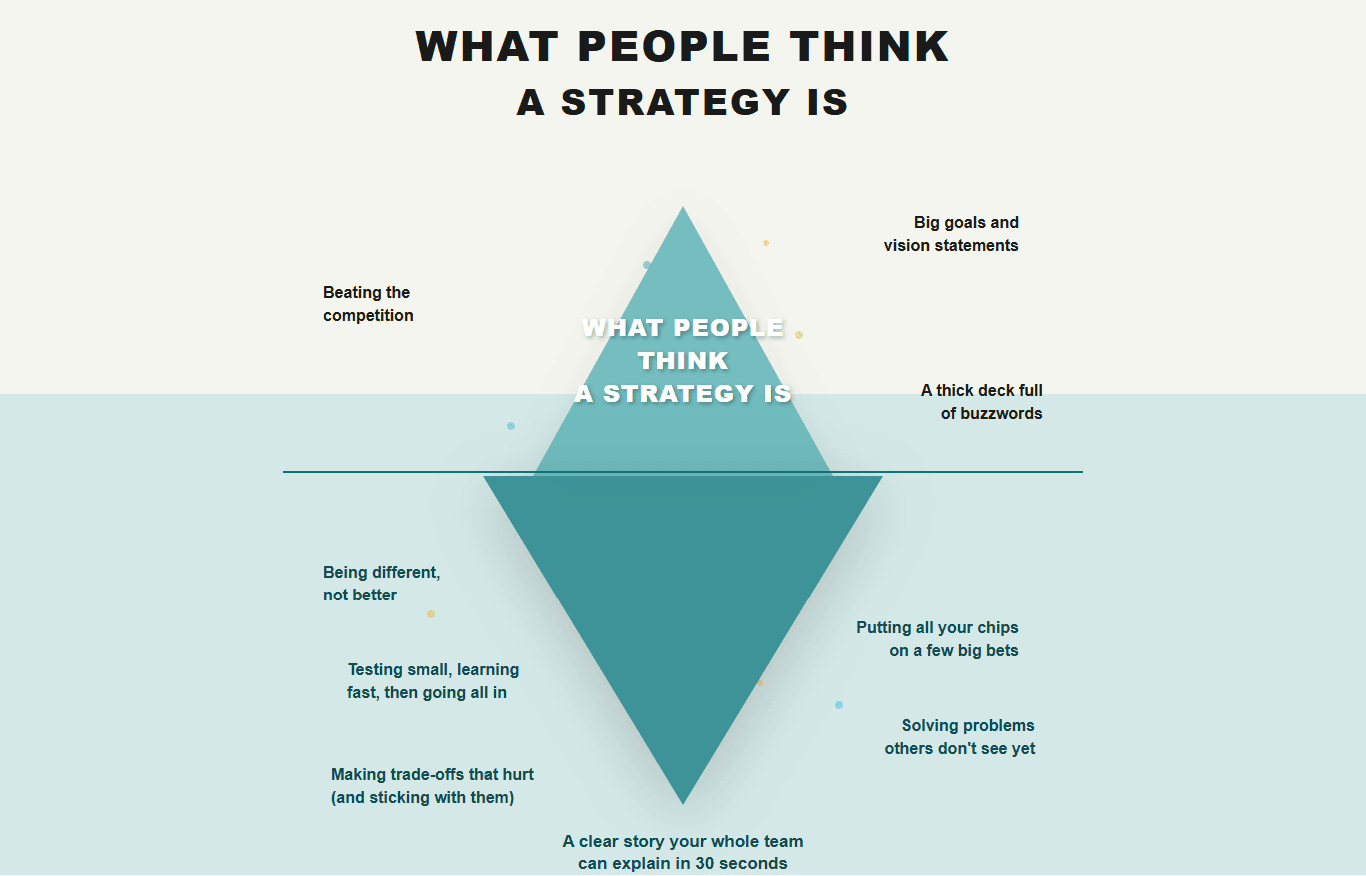
You've seen the infographic. The iceberg. What people think strategy is versus what it actually is.
Big goals at the surface. The hard work hidden below.
But here's what nobody tells you about African micro-SMEs: Most don't even have the tip of the iceberg. They're operating on floating ice chunks, hoping they don't melt before next quarter.
Everyone has a vision statement. Almost nobody has a strategy.
They know where they want to go. They just have no idea how to get there or what's actually stopping them.
What People Think Strategy Is
1. Big goals and vision statements "We want to be the leading provider of..." "Our mission is to transform..."
Beautiful. Inspirational. Utterly useless without the rest.
2. Beating the competition This is where businesses waste 60% of their mental energy. Watching competitors. Matching prices. Copying tactics.
Meanwhile, their own operations are bleeding cash through inefficiencies they can't even see.
3. A thick deck full of buzzwords "Synergy." "Disruption." "Innovation."
I've reviewed 50+ business plans from founders seeking funding. Most read like a consultant's fever dream. Ask them to explain their customer acquisition process in detail? Silence.
What Strategy Actually Is (The Part Nobody Wants to Do)
1. Choosing what NOT to do
Every "yes" without a corresponding "no" is strategic suicide.
The micro-SME serving 15 different customer segments because they're afraid to turn down revenue? That's not growth. That's fragmentation.
Real strategy means saying: "We will NOT serve enterprise clients." "We will NOT expand to 3 new cities this year." "We will NOT add 5 new product lines."
The businesses that survive? They master subtraction before addition.
2. Being different, not better
Stop trying to beat your competition at their game. Build a different game.
I worked with a logistics startup competing on price with 50 other players. Margins: razor-thin. Stress: maximum.
We shifted the strategy:
Same-day delivery for medical supplies only. Premium pricing. Certified cold-chain. Suddenly, no competition. Because nobody else wanted that complexity.
Different beats better. Every time.
3. Putting all your chips on a few big bets
Diversification is a myth sold to you by people who don't run businesses.
Your Shopify store, your physical location, your consulting arm, your online courses, your "just in case" side projects they're not assets. They're attention drains.
The most profitable SMEs I've seen? One core offer. One customer type. One distribution channel. Executed brilliantly.
4. Testing small, learning fast, then going all in
Strategy isn't a 5-year plan written in stone. It's a hypothesis you test weekly.
Launch the MVP to 10 customers. Gather feedback. Iterate. Then scale what works, kill what doesn't.
Most African SMEs do the opposite: They plan for 6 months, launch big, then pray it works. When it doesn't, they're out of cash and out of options.
5. Solving problems others don't see yet
If everyone sees the opportunity, it's already too late.
The best strategic moves happen when you spot the gap before the market does:
The regulation change coming in 18 months
The customer pain point they haven't articulated yet
The operational bottleneck your competitors ignore
This requires one thing most SMEs don't have: Data. Not guesses. Not "industry experience." Actual operational data showing you where the inefficiencies, risks, and opportunities hide.
6. Making trade-offs that hurt (and sticking with them)
Every strategy requires sacrifice:
Fast growth OR sustainable margins
Premium pricing OR high volume
Automated systems OR personal service
The companies that fail? They try to have it all. They want premium pricing AND mass market appeal. They want rapid expansion AND zero risk.
Pick your poison. Then commit.
7. Creating rules your competition can't follow
This is the deepest part of the iceberg. The part that protects everything above it.
Build systems and processes so tight, so specific to your model, that competitors can't replicate them without completely restructuring their business.
At NROLD, we do this through fractional operations analysis: We build dashboards, automated reports, and fraud detection systems tailored to your business model. Not a template. Not "best practices." Your specific reality.
When your operations run on custom intelligence, competitors can't just copy your pricing or your marketing. They'd need to rebuild from the foundation.
8. A clear story your whole team can explain in 30 seconds
If your team can't articulate your strategy in one breath, you don't have a strategy. You have confusion.
Test this tomorrow: Ask your 3 most junior employees, "What makes us different, and why do customers choose us?"
If you get 3 different answers, that's not a team alignment problem. That's a strategy problem.
The Reality for Most Micro-SMEs
Here's what I see when I audit operations:
No documented customer acquisition process.
No tracking of which products/services are actually profitable.
No systems to identify fraud, waste, or operational leaks.
No clarity on what success looks like beyond "more revenue".
They're working 60-hour weeks on the tip of the iceberg. While the base the operations, the data, the systems is melting beneath them.
The Shift You Need to Make
Stop building vision statements. Start building operational intelligence.
Answer these 5 questions with data, not feelings:
Which 20% of your customers generate 80% of your profit? (Not revenue. Profit.)
What are the 3 biggest drains on your time that don't move the business forward?
Where is cash leaking that you can't see? (Fraud, waste, inefficiency, overstaffing?)
If you lost your top 2 clients tomorrow, would you survive 90 days?
What would you stop doing if you were honest about what's not working?
If you can't answer these with numbers, you're operating on hope. And hope isn't strategy.
What This Means for You
Strategy isn't sexy. It's not the vision board or the motivational quote.
It's the hard, unglamorous work of:
Building systems that catch problems before they become crises
Saying "no" to opportunities that distract
Tracking the metrics that actually predict survival
Making trade-offs that hurt but protect your future
At NROLD, we don't write business plans. We build operational control systems that turn your data into decisions.
Because the deepest part of the iceberg the part that keeps you afloat isn't inspiration.
It's information.
What's one strategic trade-off you need to make but keep avoiding?